
Team burnout is becoming one of the most costly yet least recognized challenges for Ukrainian businesses. According to the Ukrainian Institute for the Future, the energy potential of Ukrainians has dropped by almost one-third in recent years, while presenteeism – working on ʼautopilotʼ – causes losses 12 times higher than official sick leave.
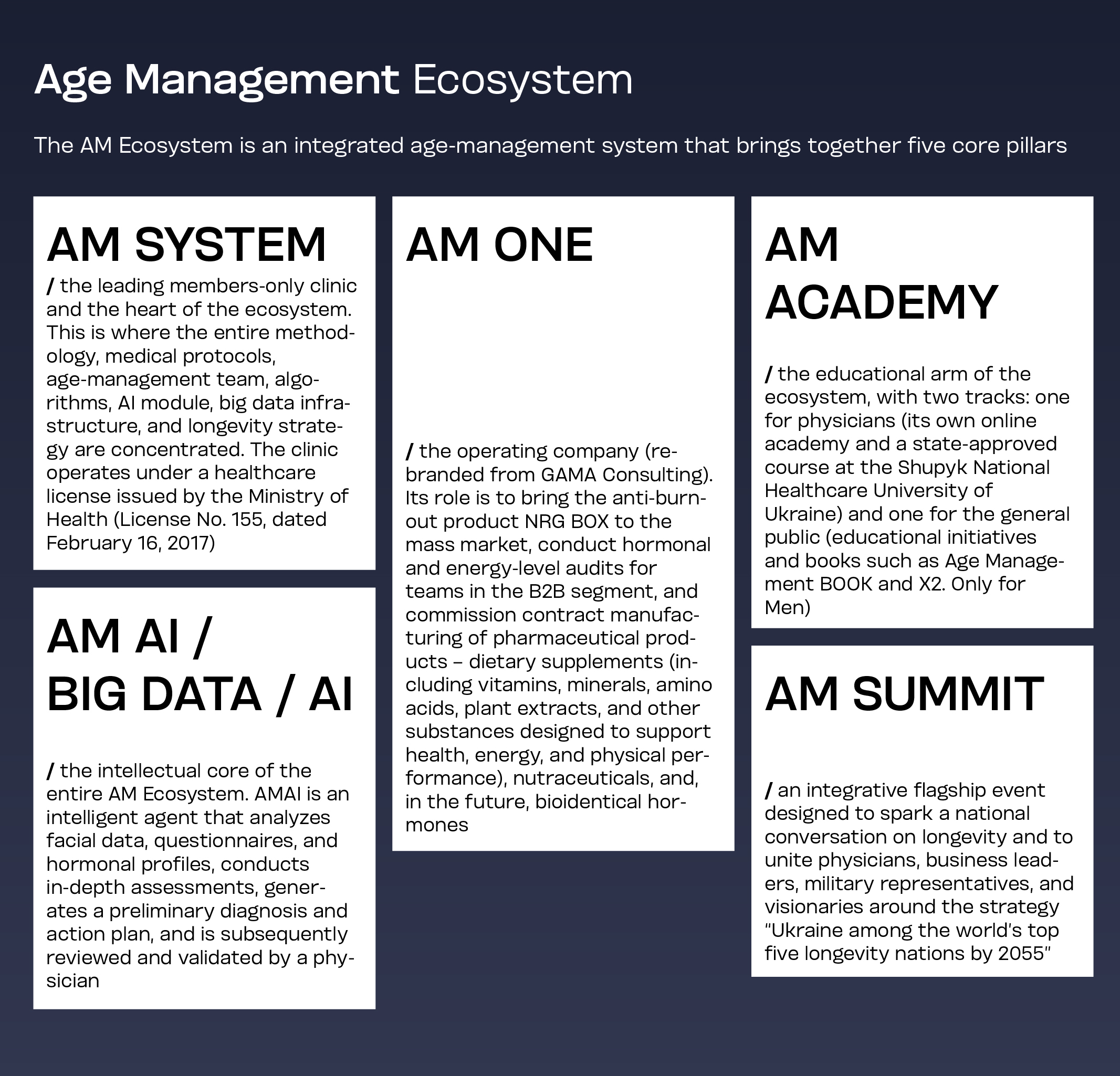
In this environment, preventive healthcare inside companies is no longer a ʼperkʼ – it’s becoming a tool for boosting productivity. The AM (Age Management) Ecosystem is an age-management system that integrates medicine, biotechnology, AI, and education into a single model. It helps companies build sustainable longevity: measuring team energy, restoring it, and directly improving financial performance. How it works – in this Forbes BrandVoice explainer.
Team Health in Wartime
For nearly four years of full-scale war, Ukrainian businesses have been operating in a state of ʼprolonged stress.ʼ
According to a study by the Ukrainian Institute for the Future (UIF), obtained by Forbes BrandVoice, the average level of energy resilience among Ukrainians has dropped by roughly one-third, while up to 86% of the population experiences some degree of psycho-emotional burnout. At the level of cardiovascular diseases, this has already led to a 15–20% increase due to chronic stress, says Anatoliy Amelin, Doctor of Public Administration, co-founder, and Director of Economic Programs at UIF.
This exhaustion is becoming a systemic risk for businesses. Companies lose money not only from official sick leave but also due to presenteeism – when employees are physically at work but operate at only 40–60% of their full capacity, according to the UIF study.
According to the same calculations, presenteeism causes 12 times more financial damage than absenteeism or official sick leave.
At the same time, Ukraine invests only 0.15% of GDP in prevention, compared to 0.8–1% in developed countries, the UIF research notes. This gap, according to Yevhen Shagov, founder of AM Ecosystem and Candidate of Medical Sciences, directly burdens businesses: companies are essentially forced to develop their own health programs if they want to maintain productive teams.
Against this backdrop, AM Ecosystem offers businesses a resilient longevity model – a managed, sustainable approach where employee health and energy become a measurable asset, rather than a ʼperk.ʼ
Why the Current Health Model Fails for the Ukrainian Corporation World
The classic health model, Shagov explains, relies on four basic pillars: sleep, nutrition, physical activity, and mental hygiene. In stable countries, this foundation is usually enough to add up to eight years of quality life, he says.
In Ukraine, however, this baseline has become nearly unattainable.
Anxiety, shelling, relocations, living between blackouts – all of this literally knocks the platform of a healthy lifestyle out from under the nation.
During the first six months of the full-scale war, Ukrainians biologically aged on average 10 years due to chronic stress, disrupted sleep, stress-related overeating, and lack of adequate physical activity, according to Ministry of Health data from June 2022.
To the wartime factor, a cultural factor is added. Shagov calls it a ʼnational indifference toward personal health.ʼ In such a mindset, people miss early signs of exhaustion and delay seeking help. As a result, companies face consequences rather than prevention – from chronic illnesses to critical burnout among key specialists – directly impacting productivity and business outcomes, Shagov emphasizes.
At the economic level, the implication is clear: the number of capable workers shrinks, while the burden on those remaining increases. Companies are forced to cover costs arising from mistakes, delays, lost focus, and chronic failures in task execution – systemically more expensive than investing in preventive measures.
Resilient Longevity: The Ukrainian Model of Longevity in Wartime
In this context, Ukraine’s technological ecosystem for preventive medicine and age management, AM Ecosystem, has developed a model of longevity and productivity designed to withstand the turbulence of wartime conditions. This is not an ʼideal healthy lifestyle,ʼ where everyone manages yoga retreats and digital detoxes, but a pragmatic system built to function in an environment of chronic stress, explains Shagov.
Resilient longevity is based on the ʼAge Management Pyramid,ʼ which Shagov and his team presented at the Age Management Summit 2025. The pyramid consists of seven interconnected levels: motivation and education, foundational habits, nutraceuticals, hormonal balance (BHRT – bioidentical hormone replacement therapy), Big Pharma clinical solutions, advanced optimization technologies (sleep, brain, metabolism), and biotech innovations.
The core principle of the system is integration, not isolated solutions.
Age Management is not about treating diseases; it’s about managing a person’s energy, resources, and longevity.
At AM Ecosystem, technologies typically applied in isolation are combined into a sequential, coherent process. First comes diagnostics – surveys, biomarkers, hormone profiling, and digital facial analysis. Then, a personalized plan is created, covering sleep, nutrition, nutraceuticals, BHRT, and other restorative tools. The next stage involves medical supervision and ongoing monitoring, and the final step is measuring results using the energy index, biomarker dynamics, and productivity improvements.
In the corporate context, this approach represents a shift from traditional ʼwellness programsʼ to systemic management of team energy resilience.
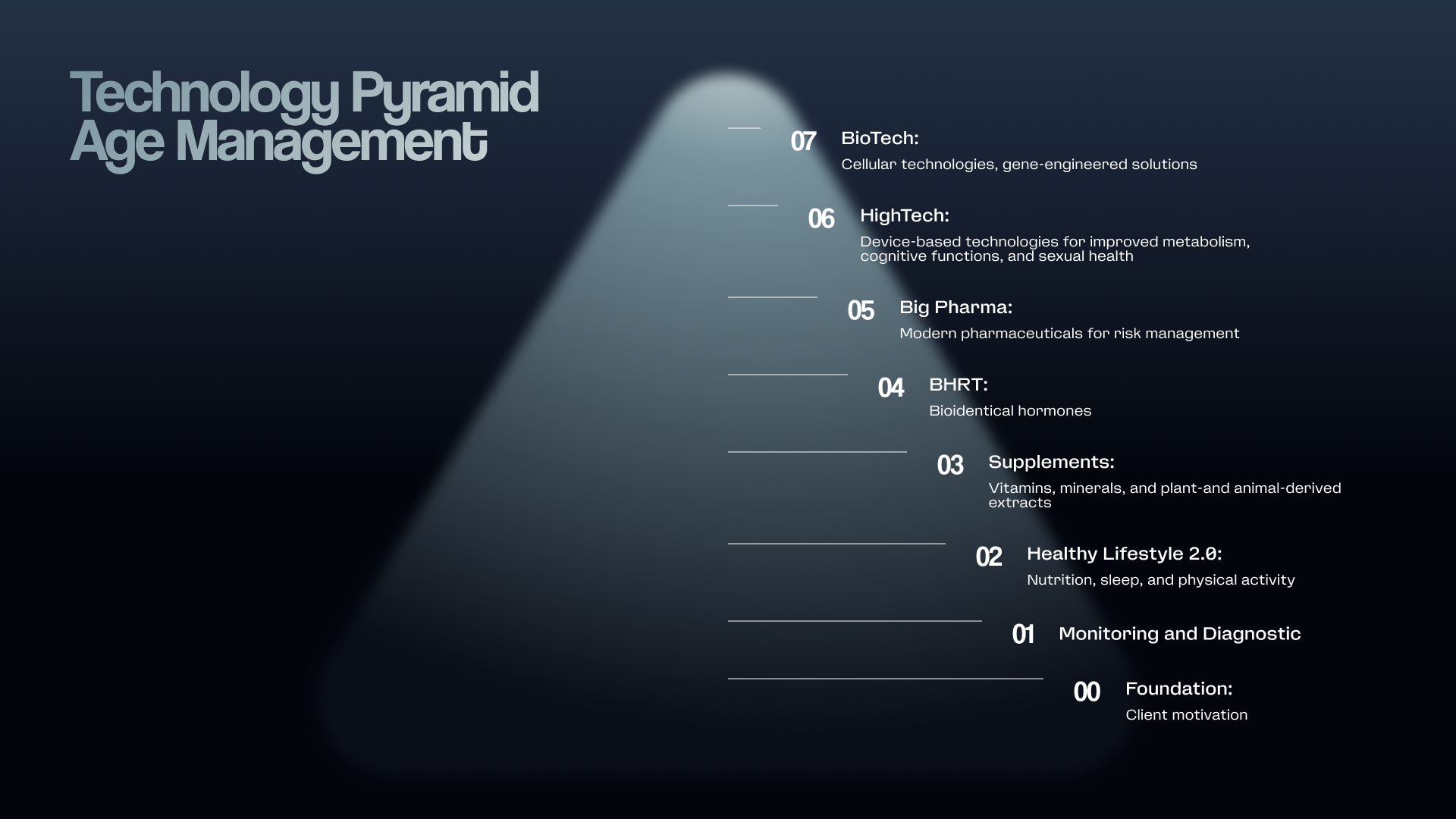
Technology Pyramid Age Management
The Health Economy: Why Prevention Delivers High ROI for Businesses
In the UIF-Amelin Strategy study, prevention is treated as a full-fledged investment tool. According to Anatoliy Amelin, every hryvnia spent on systematic preventive measures can return 3.8 to 12 hryvnias to a business.
The mechanism is simple. First, absenteeism decreases – fewer days when employees are physically absent from work.
Second, presenteeism is reduced – situations where employees are ʼpresent but not productive.ʼ The UIF study provides a case of a 50-person team: just a vitamin D deficiency in this group caused 100–150 lost workdays per year, illustrating the direct impact of nutritional deficits on productivity.
In corporate programs run by AM Ecosystem, the economic effect is measured via the EnergyScore index – an integrated assessment of an individual’s energy levels as a percentage. According to Shagov, the average EnergyScore in Ukraine today hovers around 60%. After one month of personalized programs, corporate teams see an increase of 15–17 points, and after two months, up to 23 points, he adds.
ʼIf an employee was productive for five hours out of eight, and after two months is actually working seven, that’s an extra 1.5 hours per day, multiplied across the entire staff,ʼ Shagov explains, citing AM Ecosystem client experience. ʼWe convert this into monetary value and achieve ROI ranging from 1:4 to 1:8, and in some cases, up to 1:12 within a year.ʼ
One case involved an IT cluster with 300 employees (company name undisclosed due to NDA). According to Shagov, the company invested about $130,000 in an annual preventive medicine program, including multiple waves of NRG BOX – personalized nutrient packets for morning and evening from AM Ecosystem.
The company’s internal calculations show that savings on ʼinvisibleʼ losses – presenteeism, mistakes, and delays – reached $1.4 million. This aligns with UIF analytics: as Amelin emphasizes, a 20–30% increase in cognitive productivity is roughly equivalent to gaining an additional workday per week.
How AM Ecosystem Implements Corporate Health Programs
The corporate model of AM Ecosystem begins with diagnostics. A combination of analytical questionnaires, biomarker assessments, hormone profiling, and digital facial analysis (AM FaceBot) creates an ʼenergy profileʼ for each employee and the team as a whole.
Based on this, personalized tracks are designed: sleep optimization and recovery rhythm adjustment, nutrition recommendations, individually tailored nutraceuticals with a clear goal of ʼenergy in the morning – recovery at night,ʼ hormone balancing via BHRT (bioidentical hormone replacement therapy) if needed, and restorative tools targeting the brain, metabolism, and heart rate variability.
Each employee receives a monthly supply of supplements – morning and evening packets. According to Shagov, most participants notice improved sleep quality within the first week.
After 2–3 weeks, there is a noticeable increase in energy, and by 6–8 weeks, stable cognitive clarity is achieved, as reported by client teams.
For businesses, this is supported by analytics: companies receive aggregated reports showing EnergyScore dynamics, departmental risk maps, and indicators of fatigue, sleep, and cognitive resilience. These data form the basis for calculating the ROI of prevention – as Shagov emphasizes, this is no longer just a wellness program, but a system with measurable financial results.
AM Ecosystem as Part of a National Longevity Strategy
The corporate component is only one level of the system being built by the AM Ecosystem team. The next level is national.
On October 30, 2025, the Age Management Summit was held in Kyiv, culminating in the release of the White Paper ʼAge Management – Energy of the Nation,ʼ which outlines a plan to reduce the biological age of Ukrainians by 3–5 years by 2030.
AM Ecosystem explains that NRG BOX Military and Corporate, AI screening, AM App, and AM FaceBot form a unified digital-medical framework that allows preventive solutions to be measured, predicted, and scaled. This integration makes the system suitable for a national level: technologies can be embedded into services like ʼDiia,ʼ providing personalized prevention to millions of citizens.
The White Paper, developed in collaboration with the Ukrainian Institute for the Future and the National Academy of Medical Sciences (NAMS), emphasizes that Ukraine has the opportunity to become the first country where the longevity economy is based on real data rather than declarations, thanks to digital tools, evidence-based protocols, and scalability.
The international dimension of this strategy is reinforced by AM Ecosystem’s participation in Longevity Fest A4M in Las Vegas. There, in December, Yevhen Shagov will present a dataset on the impact of chronic wartime stress on the biological age and energy levels of Ukrainians. According to him, this data provides a foundation for Ukraine to become a global model of resilient longevity – a country that creates a longevity framework other nations can follow.
Yet within the triangle of individual – business – state, it is business today that holds the greatest potential to drive systemic change, as it directly experiences the link between team energy and financial performance.
In Ukraine’s reality, the formula is simple: a healthy team builds a competitive business and strengthens the economy. That is why AM Ecosystem goes beyond private medicine, evolving into a platform for creating the country’s ʼenergy capitalʼ – a tool that simultaneously protects people, boosts productivity, and contributes to the state’s long-term resilience.